The short answer
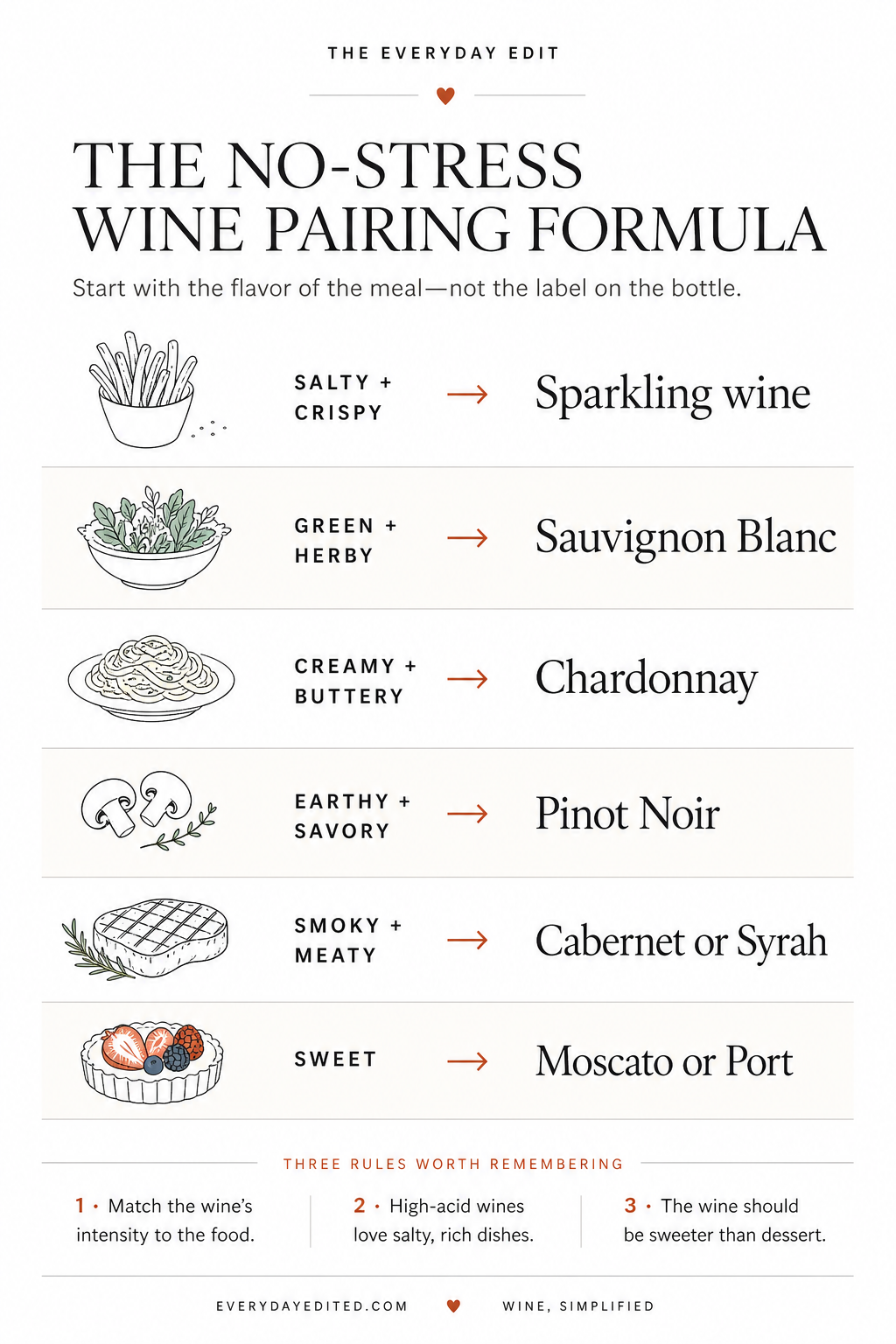
Ask three questions: What is the strongest flavor in the meal? Is the food light or rich? What style do I already enjoy? Then use a safe match: sparkling wine for salty or fried food, Sauvignon Blanc for green or citrusy dishes, Chardonnay for creamy or roasted food, Pinot Noir for earthy dishes, Cabernet or Syrah for grilled meat, and off-dry Riesling for spicy food. If you still cannot decide, choose dry sparkling wine, dry rosé, or Pinot Noir.
Wine advice becomes much more useful when it answers the question you actually have: What should I buy for this dinner? You do not need to identify obscure aromas or memorize regions. You need a short way to narrow the shelf.
Start with three questions
What is the loudest flavor on the plate?
Sauce, seasoning, and cooking method usually matter more than the protein. Roast chicken with lemon and herbs points toward a crisp white. The same chicken in a creamy mushroom sauce can handle Chardonnay or Pinot Noir. The same chicken with smoky barbecue sauce can take a fuller red.
Is dinner light, medium, or rich?
Match the weight. A delicate wine can disappear beside short ribs, while a powerful red can flatten a simple salad. Light dishes usually want crisp whites, rosé, sparkling wine, or lighter reds. Rich dishes can handle fuller whites and bolder reds.
Which style do you already enjoy?
Pairing is not a command. If you dislike Chardonnay, do not buy Chardonnay because a chart told you to. Use the meal to narrow the choices, then pick the option you would happily drink on its own.
If you need a bottle right now
- Salty, fried, or snacky food: brut sparkling wine
- Green, herby, lemony, or goat-cheese dishes: Sauvignon Blanc
- Creamy, buttery, roasted, or corn-based dishes: Chardonnay
- Mushrooms, salmon, pork, or roast chicken: Pinot Noir
- Steak, burgers, lamb, or smoky barbecue: Cabernet Sauvignon or Syrah
- Spicy food: off-dry Riesling or another lower-alcohol white with a little sweetness
- Dessert: a wine sweeter than the dessert
Real-dinner pairing cheat sheet
Pizza or tomato pasta
Choose a bright, food-friendly red such as Chianti, Sangiovese, Barbera, or a lighter Italian red. The acidity works with tomato sauce. For white pizza, try Chardonnay or dry sparkling wine. For pepperoni, dry rosé is an easy middle ground.
Tacos, salsa, or spicy takeout
Choose off-dry Riesling, sparkling wine, or a chilled dry rosé. A little sweetness can soften heat; bubbles refresh your palate. Very high-alcohol wines can make chile heat feel stronger, so this is not the moment for the biggest red on the shelf.
Creamy pasta or risotto
Choose Chardonnay when the dish is buttery, roasted, or cheesy. Choose a crisper white such as Pinot Grigio or Sauvignon Blanc when the sauce is rich but finished with lemon, herbs, or green vegetables.
Burgers or steak
Choose Cabernet Sauvignon, Syrah, Malbec, or Zinfandel. A burger with lots of toppings is also friendly with dry rosé. If the steak is served with mushrooms rather than a heavy sauce, Pinot Noir can work beautifully.
Salmon
Choose Pinot Noir, dry rosé, or a fuller white. Pinot Noir works especially well with roasted salmon and mushrooms; rosé suits grilled salmon; Chardonnay is useful with a creamy sauce.
Roast chicken
Choose by the preparation. Lemon and herbs: Sauvignon Blanc. Butter, cream, or roasted corn: Chardonnay. Mushrooms or savory herbs: Pinot Noir. Smoke or barbecue: Syrah or a fruit-forward red.
Cheese or charcuterie board
Choose brut sparkling wine when one bottle needs to handle several cheeses, salty meats, nuts, and fruit. Dry rosé is another flexible option. A bold red can overwhelm mild cheese, so save it for aged cheddar, firm sheep's-milk cheese, or meatier bites.
Chocolate or dessert
Choose a wine sweeter than the food. Port works with chocolate, caramel, nuts, and blue cheese. Moscato suits fruit, lighter cakes, and less-sweet desserts. Dry table wine beside a sugary dessert often tastes unexpectedly sharp.
How to buy wine without pretending to know wine
Use this exact store script
Say: ‘I need a dry [red/white/rosé] that is [light/medium/full] for [the meal]. I would like to spend about [$].’ That gives a shop employee five useful filters: sweetness, color, weight, food, and budget. It is much more helpful than asking for ‘a good bottle.’
Examples: ‘I need a dry, medium-bodied red for pizza around $20.’ ‘I need a crisp white for tacos around $15, and I do not want anything too sweet.’ ‘I need one flexible bottle for appetizers, and half the group does not drink red.’
Set the budget before you browse
Price is a filter, not a quality score. Decide what you are comfortable spending and ask for the best fit inside that range. You do not need to apologize for the number, and you do not need to upgrade because the label looks important.
Read only the useful parts of the label
- Grape or style: the quickest clue to flavor and body
- Region: useful context, but not a test you have to pass
- Vintage: the year the grapes were harvested; rarely the deciding factor for an everyday bottle
- Alcohol by volume: a rough clue to weight, with higher alcohol often feeling fuller
- Sweetness language: ‘dry’ means not sweet; ‘off-dry’ means a little sweetness; on sparkling wine, ‘brut’ is usually drier than ‘extra dry’
Five wine words that actually help
- Crisp: fresh acidity that makes your mouth water
- Light-bodied: delicate in weight, like skim milk rather than cream
- Full-bodied: richer and heavier on the palate
- Tannic: the drying sensation common in bold red wines
- Oaky: flavors such as vanilla, toast, cedar, smoke, or baking spice
Use those words as preferences, not grades. ‘I like crisp, dry whites’ is useful. ‘I need the best wine’ is not, because the best bottle depends on your taste, dinner, and budget.
Serve the bottle so it tastes better
Chill more wine than you think
Sparkling wine should be properly cold. White and rosé should be cool, not icy. Red usually tastes better slightly cool—roughly cellar temperature—than it does in a warm kitchen. If a red feels hot, heavy, or flat, give it a short rest in the refrigerator. If a white tastes muted, let it warm in the glass for a few minutes.
You do not need special glasses
A clean glass with enough room for a gentle swirl is enough. Stemless, mismatched, or ordinary glasses will not ruin dinner. Avoid filling to the rim; a smaller pour leaves room for aroma and is easier to handle.
Know how much is in the bottle
A standard 750-milliliter bottle gives about five 5-ounce glasses. Use that simple math when deciding how many bottles to buy: number of planned pours divided by five, then round up if you want a margin.
Refrigerate opened wine—including red
Recork or seal the bottle and put it in the refrigerator. Cold slows the changes that make an open wine taste tired. Most still wines are best finished within a few days. Let red wine warm slightly before the next pour. Sparkling wine keeps its bubbles best with a proper sparkling-wine stopper.
Quick fixes when the bottle seems wrong
- The red tastes hot or heavy: chill it briefly and try it with food
- The red feels very drying: give it air and serve it with something salty, fatty, or protein-rich
- The white tastes flat: chill it a little more
- The white tastes too sharp: let it warm for a few minutes and pair it with food
- The wine makes spicy food hotter: switch to a lower-alcohol, off-dry white or sparkling wine
- You cannot taste the wine beside dinner: the food is probably heavier; choose a fuller style next time
- The wine overpowers dinner: move toward a lighter style next time
Three things you can stop worrying about
Screw cap versus cork
A screw cap is not a warning sign. It is a practical closure and does not automatically mean the wine is cheap or lower quality.
The correct pronunciation
You can point to the label or describe the style you want. A useful wine shop will help without turning pronunciation into a performance.
Finding the perfect pairing
There is rarely one correct bottle. The goal is a pleasant match: similar weight, no major flavor collision, and a wine you like. That is enough for Tuesday dinner and most dinner parties.
Everyday Edited takeaway
Start with the dominant flavor, match the weight of the meal, and stay inside a style and budget you actually enjoy. Keep three fallback bottles in mind: dry sparkling wine for salty or mixed foods, dry rosé for a table with several flavors, and Pinot Noir when you need a flexible red.

What actually helps
- Use the store script: color, dry or sweet, light or full, the meal, and your budget.
- Keep three fallback bottles in mind: brut sparkling wine, dry rosé, and Pinot Noir.
- Chill warm red wine briefly; let over-cold white wine warm in the glass.
- Recork opened wine and refrigerate it, including red wine.
- Plan on about five 5-ounce pours from a standard 750-milliliter bottle.
Best for
Anyone standing in a wine aisle, ordering for dinner, bringing a bottle to someone else's house, or serving guests without wanting a sommelier-level education.
Skip if
You need producer-specific buying advice, vintage analysis, cellar recommendations, or guidance for a rare or expensive bottle.
Frequently asked questions
What wine should I buy when I do not know what everyone likes?
Dry sparkling wine and dry rosé are flexible choices for mixed appetizers and varied meals. If the group wants red, Pinot Noir is a lighter, food-friendly default. Give the store your budget so they can narrow the shelf.
What wine is best with spicy food?
Try off-dry Riesling, sparkling wine, or chilled rosé. A little sweetness can soften chile heat, while very high-alcohol wine can make the heat feel stronger.
Should red wine be chilled?
Most red wine tastes more balanced slightly cool, around 55–65°F, than it does in a warm room. A short refrigerator chill can help; very light reds can be served near the cooler end of that range.
How many glasses are in a bottle of wine?
A standard 750-milliliter bottle contains about five 5-ounce glasses. Divide the number of pours you plan to serve by five to estimate the number of bottles.
How should I store wine after opening it?
Recork or seal the bottle and refrigerate it, including red wine. Most still wines are best within a few days; let red wine warm slightly before serving again. Use a sparkling-wine stopper for bubbles.
What should a beginner look for on a wine label?
Start with the grape or style, whether it is dry or off-dry, the alcohol level, and the price. Region and vintage can add context, but they do not need to drive an everyday purchase.
