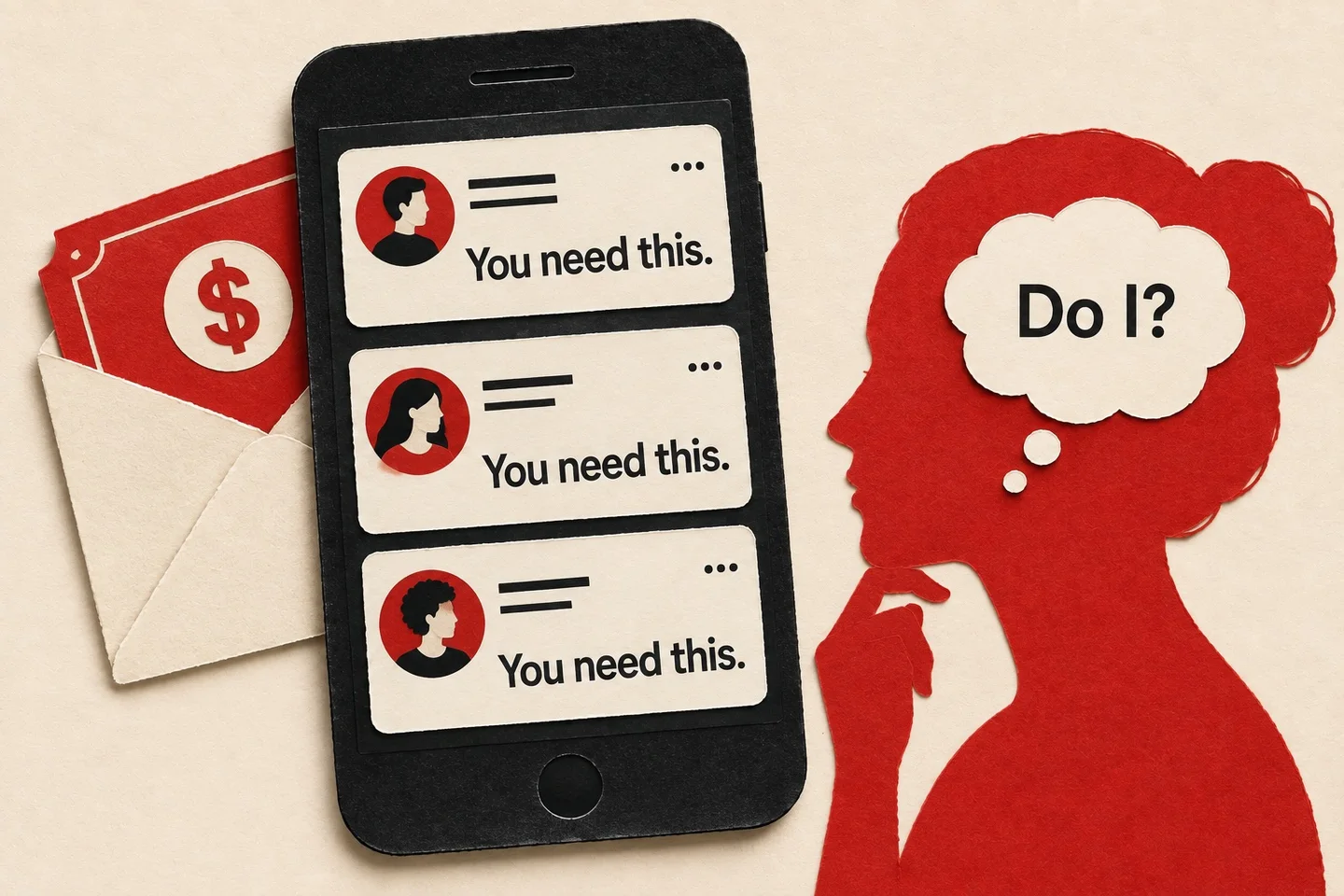
You know to pause when a creator says a moisturizer changed her life and the post says #ad. You can enjoy the recommendation while remembering that someone paid for it.
But what if the sales pitch starts three videos earlier, with the idea that your skin barrier is damaged?
By the time the moisturizer appears, you may already believe you have a problem to fix. We've learned to look for an ad label on a product. We don't always think to look for the money behind an idea.
How does social media influence what you believe?
Social media can shape what feels normal, necessary, risky, or true through repeated claims, familiar creators, paid promotion, and personalized feeds. Sometimes the idea reaches you before the product—and the incentive behind the message isn't obvious.
That influence can reach your bathroom shelf, grocery list, parenting decisions, spending habits, and opinions. It can start with something as small as the feeling that everyone else knows something you don't.
Can influencers be paid to promote ideas?
Yes. Paid influence can promote a viewpoint, an issue, or a candidate as well as a product. And sometimes the audience isn't clearly told about the payment.
The Associated Press has reported on political content created for payment without clear disclosure, including a video commissioned by a Democratic campaign and posts defending a Republican official. That is a documented example of money supporting messages that viewers might otherwise read as personal opinion. Read the AP reporting on paid political creators.
The everyday lesson applies whichever views you hold: a post that sounds spontaneous may have a sponsor, an organizer, or a strategic purpose behind it. You often can't establish that just by watching.
In commercial content, sponsorships, free products, affiliate commissions, and PR outreach give creators reasons to cover particular subjects. A paid post might introduce a product; the surrounding conversation can help make the problem it promises to solve feel important.
That doesn't mean everyone repeating the idea was paid. A trend can gather unpaid fans, sincere recommendations, and people simply joining a popular conversation.
A creator can genuinely believe something and have a financial incentive to talk about it. Both can be true.
What an ad label can—and can't—tell you
For U.S. brand endorsements, the FTC says relationships that could affect how people judge a recommendation should be clearly disclosed. That includes payment and free or discounted products. Disclosures should be easy to notice, alongside the endorsement, rather than buried in a profile or behind “more.” FTC guidance for influencers.
Those are commercial endorsement guidelines, not a single rule covering every political opinion or online idea.
A missing label doesn't establish that a post is independent. It also doesn't prove someone secretly paid for it. A label tells you about the relationship; evidence tells you about the claim.
Beauty: first you discover the problem, then the serum
Imagine this sequence. One creator says your skin barrier needs repair. Another explains why your routine isn't doing enough. A third shares the products that finally helped her.
You hadn't been worried about your skin on Monday. By Friday, you're comparing repair creams.
This is an illustrative scenario, not an allegation about a particular creator or brand. Notice the two separate things you've been asked to accept: “I have this problem” and “this product will solve it.” Each needs its own support.
Other versions might be “clean beauty is safer,” “everyone needs a ten-step routine,” or “you should start fighting aging in your twenties.” These are examples of messages to question, not skincare advice.
Before comparing products, ask whether the underlying claim applies to you. A brand doesn't have to win your purchase today if you've already decided you need a whole new category of care.
Wellness: a real subject can become a sales pitch
Picture a feed suddenly full of cortisol, inflammation, gut health, or blood sugar. Soon you're wondering whether your afternoon slump has an explanation you somehow missed—and whether a supplement subscription is the answer.
The existence of a legitimate health topic doesn't establish the next three claims: that you have a problem, that it explains your symptoms, and that the advertised solution will help.
The same distinction matters when a video tells you to fear seed oils, avoid an ingredient, or “balance” your hormones. What exactly is the claim? What research supports it? Does that research concern people like you and the actual product being sold?
A testimonial describes someone's experience. It cannot, on its own, show what caused an improvement or predict your result. NIH's consumer guidance encourages checking where health information comes from, whether it rests on research, and whether the source is selling something. NIH's questions for evaluating health information on social media.
If symptoms concern you, take them to a qualified clinician. A familiar video isn't a diagnosis, and checking a claim shouldn't mean ignoring how you feel.
Lifestyle: when an optional purchase starts feeling required
Imagine seeing a walking pad in every work-from-home routine, the same water bottle in every gym bag, or a morning ritual that requires six products and an earlier alarm.
After enough appearances, “that looks nice” can become “I'm doing this wrong without it.” Even parenting advice can arrive with the suggestion that caring properly requires a particular course, toy, or method.
The useful question is specific: What would this improve in my actual day?
A walking pad might fit your life beautifully. So might walking outside. A bottle you love might be worth buying. The one in your cupboard may still hold water with impressive consistency.
You can want something without needing it. Naming the difference gives you a better starting point for deciding what deserves your money.
Why “I keep seeing it” feels like evidence
Several things can happen at once:
- Repetition creates familiarity. Experiments have found that repeated statements can seem more truthful, even when people have knowledge that contradicts them. Researchers call this the “illusory truth effect.” It is a tendency, not a guarantee that repetition changes everyone's mind. Read the study.
- Different faces can look like independent agreement. Five creators may all be drawing on the same clip, press release, or study. Five posts aren't necessarily five sources.
- A familiar person feels approachable. Advice delivered between someone's recipes and dog videos can feel more personal than a conventional advertisement. That feeling doesn't reveal their expertise or business relationships.
- Your feed responds to your attention. TikTok describes using signals such as likes, shares, follows, and video viewing to personalize recommendations. Engaging with a topic can help bring you more of it. How TikTok explains its recommendations.
“Everyone is talking about this” may really mean “my feed keeps showing me this.” Your feed is a selection, not a survey.
If scrolling itself is becoming hard to put down, our guide to how too much scrolling can affect your day offers a separate place to start.
Who benefits if I believe this? Five questions to keep
When a new concern or must-have starts following you around, try this quick check:
- Who benefits? Look for a seller, affiliate link, sponsor, campaign, or paid service. Someone benefiting is a reason to examine the evidence—not a verdict that the idea is wrong.
- What problem am I being asked to believe I have? Did I notice it in my life, or only after repeated posts? Would it still matter if nobody were selling a solution?
- Where did the claim start? Follow the link to the original research or reporting. Do the other accounts add independent evidence, or just repeat it?
- What would change my mind? Look for the limits as well as the benefits. A useful explanation should tell you who a claim applies to and what remains uncertain.
- Why does it feel urgent or universal? Is there a real deadline or widespread need—or have repetition, a sale countdown, and my recommendations made it feel that way?
You don't need to investigate every water bottle. Save the deeper checking for claims that could change your health, budget, family decisions, or treatment of other people.
Before you buy or believe it: one search, one pause
Search the claim without the product name. Then give a nonessential purchase a day.
For example, instead of searching for reviews of a “hormone-balancing” supplement, first investigate the specific health claim through an established medical source. Look for evidence beyond testimonials, and check who funds or sells the advice. A polished page can still be a sales page.
Or, before buying the walking pad, write down the problem you want it to solve. Would it help you move during meetings? Do you have the space? Would you use it after the novelty fades?
You may still buy it. You may still agree with the creator. The pause simply gives your own needs and the evidence a turn in the conversation.
Your feed can introduce you to wonderful things. It doesn't get to decide what your life is missing.
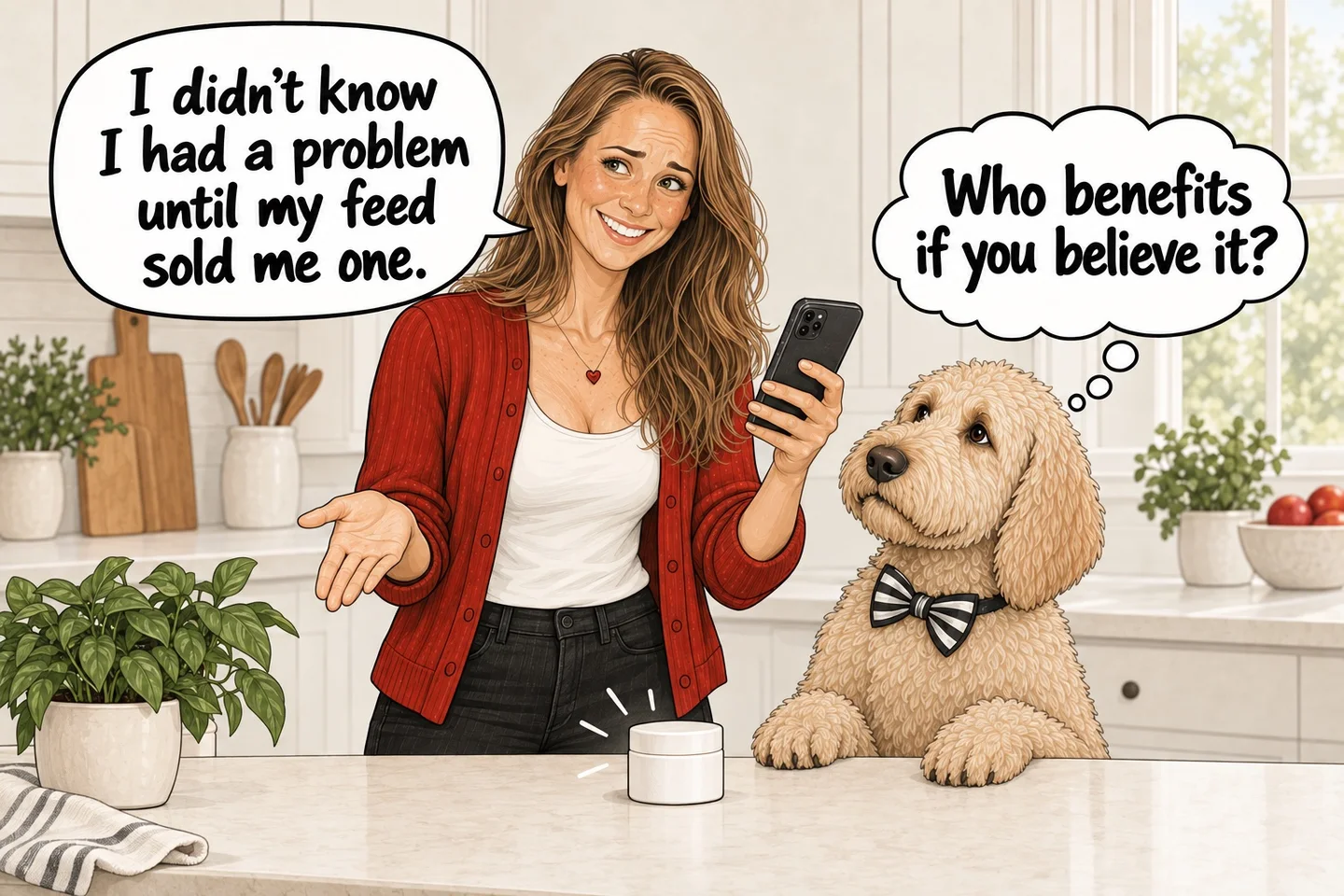
Before “I keep seeing this” becomes “I need this” or “I know this,” ask: Who benefits if I believe this?
Related reads

Why Too Much Scrolling Can Be Bad for You
Why scrolling can leave you distracted, anxious, tired, and dissatisfied—and what research actually tells us about the habit.
Read article →