The short answer
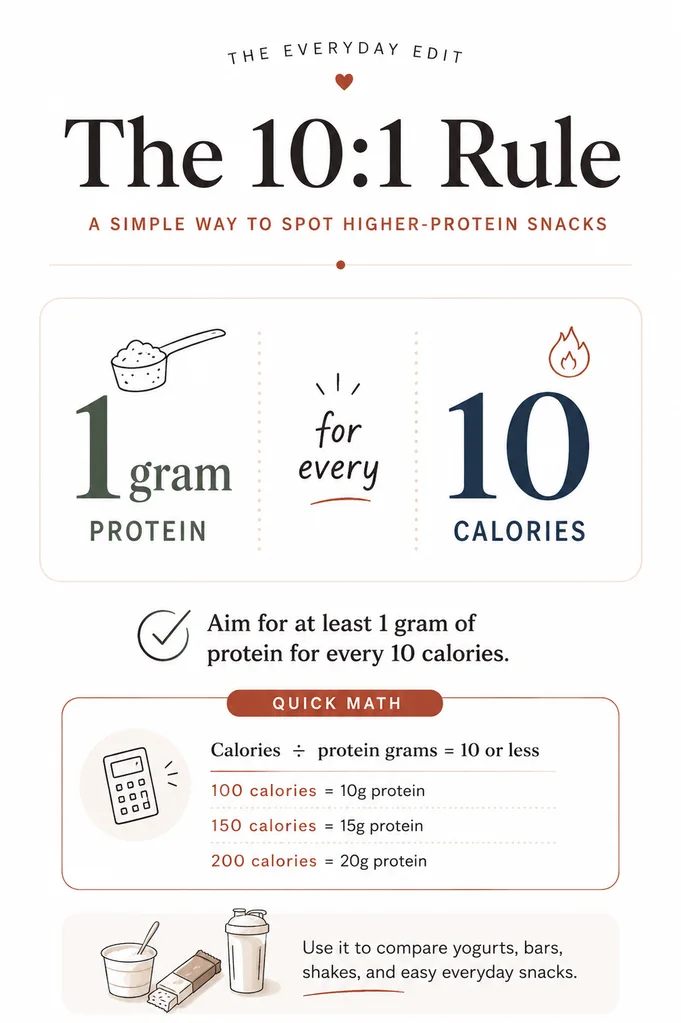
A snack meets the 10:1 protein rule when it has at least 1 gram of protein for every 10 calories. It is not an official nutrition guideline, but it can be a useful shortcut for finding snacks that provide a meaningful amount of protein for their calories.
Some snacks are advertised as “high protein” even though they contain only a few grams of protein and enough calories to count as a small meal.
That is why I like the 10:1 protein rule.
It is not an official nutrition guideline, and it does not mean that every food you eat needs to follow it. It is simply a quick way to find foods that provide a meaningful amount of protein without using up a large portion of your daily calories.
What is the 10:1 protein rule?
A food meets the 10:1 rule when it contains approximately:
To check a food, divide the calories by the grams of protein.
For example:
- 150 calories ÷ 15 grams of protein = 10
- 100 calories ÷ 12 grams of protein = 8.3
- 200 calories ÷ 10 grams of protein = 20
The first two foods meet the rule. The third does not.
An even easier shortcut is to remove the final zero from the calorie count.
A snack with 150 calories should contain at least 15 grams of protein. A snack with 200 calories should contain at least 20 grams.
Why the rule can be useful
Protein can help make a snack feel more satisfying, especially when you are trying to avoid feeling hungry again 20 minutes later.
The 10:1 rule is particularly useful when you are:
- Comparing protein bars
- Looking for filling work snacks
- Choosing between different yogurts
- Trying to increase protein without dramatically increasing calories
- Shopping for convenient foods at Walmart, Target, or Costco
- Building a snack that will hold you over until your next meal
It is a screening tool—not a complete measure of whether a food is healthy.
Fiber, vitamins, ingredients, sodium, added sugar, and how the food makes you feel still matter.
25 snacks that meet the 10:1 protein rule
Nutrition information varies by brand and serving size, so always check the package. The numbers below are typical estimates.
Nonfat Greek yogurt
Approximately 90 calories and 15 grams of protein
Plain nonfat Greek yogurt is one of the easiest foods to find that comfortably passes the rule.
Add berries, cinnamon, or a small amount of zero-calorie sweetener to make it more interesting.
Low-fat cottage cheese
Approximately 100 calories and 13–14 grams of protein
Cottage cheese works as either a sweet or savory snack.
Try it with berries and cinnamon, or add pepper, cucumber, and everything-bagel seasoning.
A tuna pouch
Approximately 70 calories and 15–17 grams of protein
Tuna pouches are shelf-stable, portable, and usually require no preparation.
Eat one with cucumber slices, mini peppers, or a few whole-grain crackers.
Deli turkey roll-ups
Approximately 90 calories and 15 grams of protein
Roll several slices of turkey around pickle spears, cucumber strips, or a light cheese stick.
Check the sodium level if deli meat is something you eat frequently.
Cooked shrimp
Approximately 100 calories and 20 grams of protein
Cold cooked shrimp makes a surprisingly convenient snack.
Serve it with cocktail sauce, lemon, or a Greek-yogurt-based dip.
Egg-white bites
Approximately 100 calories and 15 grams of protein
Egg whites contain most of the protein in an egg without as many calories as the yolk.
Bake egg whites with spinach, peppers, and a small amount of cheese in a muffin pan for easy grab-and-go snacks.
A ready-to-drink protein shake
Approximately 150–170 calories and 25–30 grams of protein
A protein shake can be useful when you need something fast and do not have access to a refrigerator or full meal.
Look for one that has at least 20 grams of protein and is not loaded with added sugar.
A protein bar that passes the math
Approximately 180 calories and 20 grams of protein
Not every protein bar meets the rule.
A 200-calorie bar should contain at least 20 grams of protein. A bar with 220 calories and only 10 grams of protein may still taste good, but it does not pass the 10:1 test.
Turkey jerky
Approximately 80 calories and 10 grams of protein
Jerky can be an easy desk, car, or travel snack.
Compare labels carefully because some varieties contain much more sugar and fewer grams of protein than others.
Lean beef jerky
Approximately 80–100 calories and 10–12 grams of protein
Look for a lean variety with at least 10 grams of protein per 100 calories.
Jerky is convenient, although it can be high in sodium.
Smoked salmon
Approximately 100 calories and 16–18 grams of protein
Roll smoked salmon around cucumber slices or spread a little light cream cheese inside.
It feels more substantial than many packaged snacks while still providing a strong protein-to-calorie ratio.
Roasted chicken breast
Approximately 120 calories and 23 grams of protein
A few ounces of leftover chicken can become a snack with almost no effort.
Pair it with mustard, pickles, cucumber slices, or cherry tomatoes.
Canned chicken with Greek yogurt
Approximately 140 calories and 24 grams of protein
Mix canned chicken with plain Greek yogurt, mustard, and seasoning.
Eat it as a dip with sliced vegetables or spoon it into lettuce cups.
Lean roast beef roll-ups
Approximately 100 calories and 16 grams of protein
Wrap roast beef around pickle spears or thin bell-pepper slices.
This is another convenient option that feels more like real food than a packaged snack.
Light string cheese
Approximately 50 calories and 6 grams of protein
Many regular cheese sticks narrowly miss the 10:1 rule, but some light varieties meet it.
Check for at least 6 grams of protein in a cheese stick with around 50–60 calories.
Greek-yogurt ranch dip
Approximately 100 calories and 15 grams of protein
Mix plain Greek yogurt with ranch seasoning, garlic powder, or fresh herbs.
Serve it with carrots, cucumbers, celery, and mini peppers.
Cottage-cheese vegetable dip
Approximately 120 calories and 16 grams of protein
Blend cottage cheese until smooth, then add herbs and seasoning.
It creates a creamy, high-protein dip without relying on mayonnaise or sour cream.
Greek-yogurt protein pudding
Approximately 170 calories and 25 grams of protein
Mix Greek yogurt with a partial scoop of protein powder.
Add a little milk if needed to create a pudding-like texture. Chocolate, vanilla, and cheesecake-flavored protein powders all work well.
Frozen Greek-yogurt bark
Approximately 140 calories and 17 grams of protein
Spread Greek yogurt on a lined tray, add berries, and freeze.
Break it into pieces and store them in the freezer for a cold snack that feels more like dessert.
Protein hot chocolate
Approximately 150 calories and 20 grams of protein
Mix chocolate protein powder with warm milk or a lower-calorie milk alternative.
Avoid adding protein powder to boiling liquid because it can clump. Mix it first with a small amount of cool liquid, then slowly add the warm milk.
Seitan strips
Approximately 100 calories and 18–20 grams of protein
Seitan is one of the most protein-dense plant-based options.
It can be eaten cold, warmed in a pan, or dipped in mustard or a yogurt-based sauce.
It is made from wheat gluten, so it is not appropriate for anyone avoiding gluten.
Extra-firm tofu bites
Approximately 100 calories and 11–13 grams of protein
Bake or air-fry seasoned extra-firm tofu until the outside becomes crisp.
The exact ratio varies, so compare brands and serving sizes.
Dry-roasted edamame
Approximately 130 calories and 14 grams of protein
Regular steamed edamame may narrowly miss the rule depending on the serving, but dry-roasted edamame is often more protein-dense.
It is also crunchy and easy to keep at your desk.
Lupini beans
Approximately 100 calories and 12 grams of protein
Lupini beans are firm, salty, and easy to eat straight from the container.
They can be high in sodium, so rinsing them may help.
A simple chicken snack box
Approximately 180 calories and 28 grams of protein
Combine:
- Sliced chicken breast
- Cucumbers or peppers
- Mustard or Greek-yogurt dip
- A light cheese stick
This is a good option when a yogurt or protein bar does not feel substantial enough.
Popular “high-protein” snacks that may not pass
A food can still be nutritious even when it does not follow the rule.
However, some foods contain less protein for their calories than people expect.
Whole eggs
One large egg typically contains around 70 calories and 6 grams of protein.
That is close, but it does not quite meet the rule. Pairing one whole egg with additional egg whites improves the ratio.
Peanut butter
Two tablespoons commonly contain around 190 calories and 7–8 grams of protein.
Peanut butter contains protein, but most of its calories come from fat. It can still be satisfying and nutritious—it simply is not a protein-dense food.
Nuts
Nuts provide healthy fats, fiber, and micronutrients, but most do not meet the 10:1 protein rule.
Hummus
Hummus can be a useful source of fiber and healthy fat, but it usually does not provide enough protein to pass the rule on its own.
Regular cheese
Many regular cheese sticks contain around 80 calories and 6–7 grams of protein.
That makes them close, but not always a true 10:1 option.
Granola and many “protein” cereals
A product can use the word “protein” on the package without being especially protein-dense.
Always check the actual calories and protein grams.
How to improve a snack that does not meet the rule
You do not have to stop eating foods you enjoy.
Instead, combine them with a leaner protein source.
Try:
- One whole egg plus egg whites
- Peanut butter mixed into Greek yogurt
- Hummus served with turkey slices
- Nuts added to cottage cheese rather than eaten alone
- Fruit paired with Greek yogurt
- Crackers topped with tuna or chicken
- Regular cheese paired with lean deli turkey
- Granola used as a topping instead of the main part of the snack
The goal is not to create a perfect mathematical meal. It is to make the snack more filling and balanced.
The easiest 10:1 snacks to keep on hand
For the refrigerator
- Greek yogurt
- Cottage cheese
- Light string cheese
- Deli turkey
- Cooked chicken
- Egg-white bites
- Smoked salmon
- Cooked shrimp
For the pantry or office
- Tuna pouches
- Turkey jerky
- Lean beef jerky
- Protein bars
- Protein powder
- Dry-roasted edamame
- Lupini beans
- Ready-to-drink protein shakes
For the freezer
- Greek-yogurt bark
- Frozen cooked shrimp
- Homemade egg-white bites
- Pre-portioned cooked chicken
- High-protein smoothie ingredients
A few things to remember
The 10:1 rule is useful, but it should not become another rigid food rule.
Some foods that do not pass the calculation—such as avocados, nuts, olive oil, fruit, and whole eggs—can still be part of a healthy diet.
The rule works best when you use it to compare similar options.
For example:
- One yogurt versus another yogurt
- Two different protein bars
- Different kinds of jerky
- A regular cheese stick versus a light cheese stick
- Two ready-to-drink protein shakes
It is simply a fast way to answer:
Am I getting a meaningful amount of protein for these calories?
For snacks, that can be a very helpful question.
Everyday Edited takeaway
The easiest place to start is with Greek yogurt, cottage cheese, tuna pouches, deli turkey, egg whites, and a protein shake you genuinely enjoy.
You do not need every snack to be perfect. But when you want something that is more likely to keep you full, the 10:1 rule makes reading a nutrition label much easier.
Save the simple formula:
That is it.

Frequently asked questions
What is the 10:1 protein rule?
It is a quick screening tool for finding foods with at least 1 gram of protein for every 10 calories. It is not an official nutrition guideline.
How do I calculate the 10:1 protein rule?
Divide the calories by the grams of protein. A result of 10 or less meets the rule. As a shortcut, remove the final zero from the calories to find the minimum grams of protein.
Does every snack need to meet the 10:1 rule?
No. Foods that do not pass can still be nutritious. The rule works best when you use it to compare similar snack options.